
A master’s student in clinical psychology sends out around thirty unsolicited applications in two weeks and receives no responses. The problem does not always lie with the CV: often, it is the targeting of organizations and the timing of the outreach that pose issues. Searching for an internship in clinical psychology requires a method suited to a field where positions are scarce, university requirements are specific, and administrative timelines are long.
Internship agreement and university requirements: what to check before applying
Before sending any applications, one should start by reviewing the specifications of their master’s program. Not all organizations allow for the validation of the same competencies, and a poorly targeted internship may be rejected by the educational team after signing.
The professional internship required for the title of psychologist demands at least 500 hours supervised by a designated psychologist. This volume is not to be confused with an exploratory or research internship, which serves different objectives and durations. Confusing the two formats is a common mistake at the beginning of one’s journey.
The internship agreement must specify the assigned tasks, the targeted competencies, the name of the supervisor in the organization, and that of the academic advisor. One also checks the issue of compensation: in France, it becomes mandatory as soon as the presence exceeds two months (consecutive or not) in the same organization during the same academic year.
The legal minimum announced for 2026 is 4.50 euros per hour of actual presence. Some hospital or non-profit organizations ignore this obligation, which can complicate the signing of the agreement.
To find an internship in clinical psychology that truly meets the validation expectations, one systematically cross-references the proposed job description with their university’s internship booklet. This cross-checking avoids unpleasant surprises at the end of the journey.

Targeting host organizations in clinical psychology: beyond hospitals
The majority of students focus their applications on the psychiatric services of university hospitals. These services receive dozens of applications each year, and positions are often allocated as early as March for the following academic year.
Expanding the search perimeter changes the game. Several types of organizations host interns in clinical psychology and remain underutilized:
- Medical-psychological centers (CMP) and medical-psychopedagogical centers (CMPP), which offer direct contact with diverse populations and often provide individualized supervision.
- Residential facilities for dependent elderly people (EHPAD), where the clinical aspect of psychological work (cognitive assessment, family support, end-of-life care) is substantial.
- Social child welfare homes (MECS) and social assistance homes for children (ASE), which allow for work on trauma and attachment clinical issues.
- Associations specialized in addiction, reintegration, or victimology, which sometimes have psychologist positions but struggle to attract interns.
Contacting the psychologist directly at the organization (and not the HR department) increases the chances of receiving a response. A clinical psychologist who supervises an intern often does so out of personal commitment. An email addressed to the right person is worth more than ten generic applications sent through an institutional form.
Application timeline and follow-ups: the time factor
In clinical psychology, the search timeline does not align with that of other fields. Public organizations operate with commissions or hierarchical validations that take several weeks. Sending an application in September for an internship starting in October is almost always too late.
One should start the process six months before the desired start date. For an internship in the second semester (January-February), initial contacts should be made as early as July. For an internship starting in September, one should prospect in March-April.
Tailoring the cover letter to the clinical field
The cover letter for a clinical internship does not resemble a standard letter. The psychologist reading it wants to understand three things: what is the student’s clinical project, why this specific organization, and what theoretical framework guides their thinking.
Mentioning a theoretical orientation (psychoanalytic, cognitive-behavioral, integrative) is not a detail. Some services operate according to a specific framework, and showing coherence between one’s approach and that of the field reassures the internship supervisor. One should avoid vague formulations like “I wish to deepen my clinical practice” in favor of a paragraph that describes an interest in a specific population or issue encountered in class or reading.
Follow up without harassing
A follow-up email seven to ten days after the initial send is normal and expected. One briefly restates their motivation and suggests a time slot for a phone call. After two follow-ups without a response, one should move on to another organization.
Internship interview in clinical psychology: what really matters
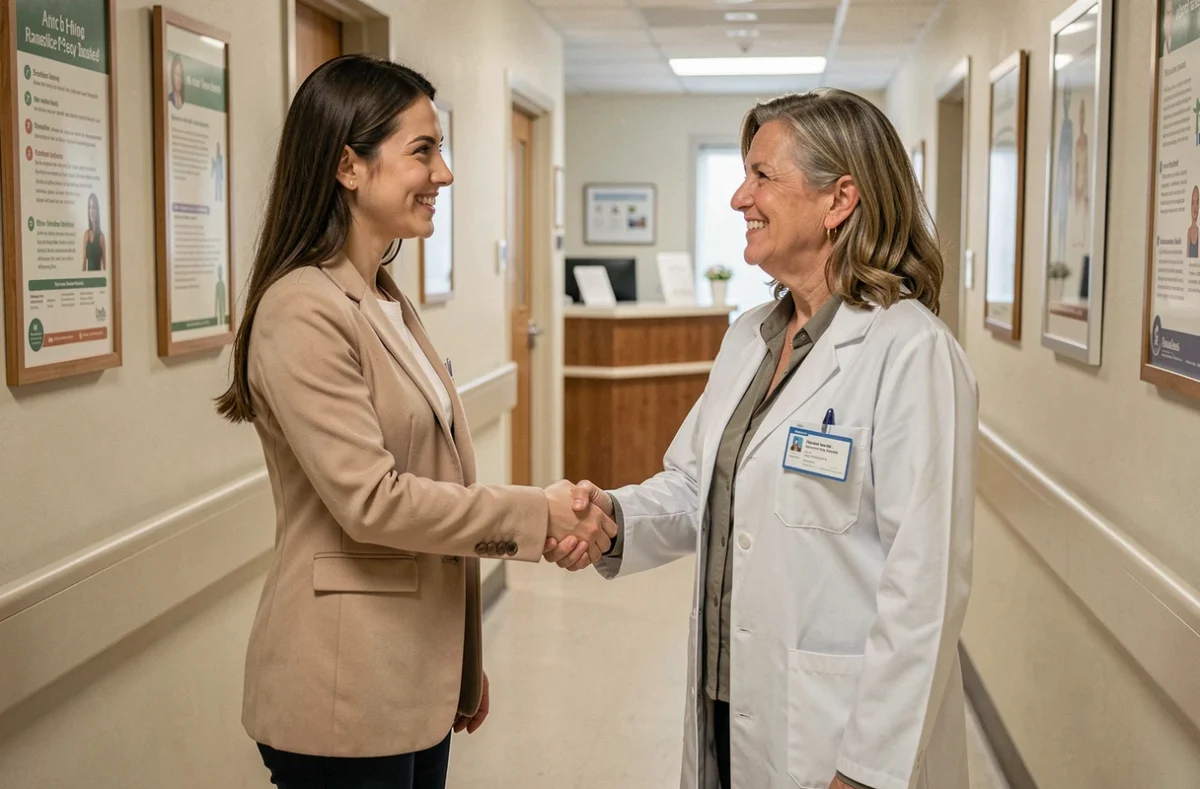
The interview with an internship supervisor in clinical psychology is not a job interview. The psychologist primarily assesses the intern’s ability to adopt a listening posture, endure silence, and tolerate clinical uncertainty.
We are rarely asked to recite a psychopathology course. The questions are more about concrete situations: how one would react to a patient in crisis, what one would do if feeling overwhelmed by a situation, how one envisions supervision. Demonstrating that one has reflected on their own limits matters more than projecting a facade of confidence.
Preparing two or three questions about the team’s functioning, the frequency of supervisions, or the evaluation tools used shows genuine interest in the field. One should avoid questions about hours or days of presence initially, even if these aspects will naturally be addressed later.
The number of available positions varies greatly depending on regions, specialties, and years. In major university cities, competition remains fierce in hospital settings, while some rural or suburban organizations actively seek interns without success. Expanding one’s geographical area by a few dozen kilometers can be enough to unlock a search that has stagnated for months.